
Please click the button below to go to our email login page
|
The First & Corresponding Author as a Postdoctor: The “Too-Radical” Project That Worried Their Mentor Has Finally Came to Fruition“Is is model too aggressive?”
In the winter of 2021, when Yaqiao Li excitedly shared her experimental plan with her mentor, her mentor Yadong Huang had some concerns.
Yaqiao Li considered to hybridize mouse models with abnormal tau and Aβ proteins and then conduct drug test. The aberrant deposits of these two proteins are key pathological features for Alzheimer’s disease.
However, the common Alzheimer’s disease model only contains one type of mutation. If two types of mutations are applied simultaneously, the mice will become more vulnerable and there will be a risk of reducing the success rate of the experiments.
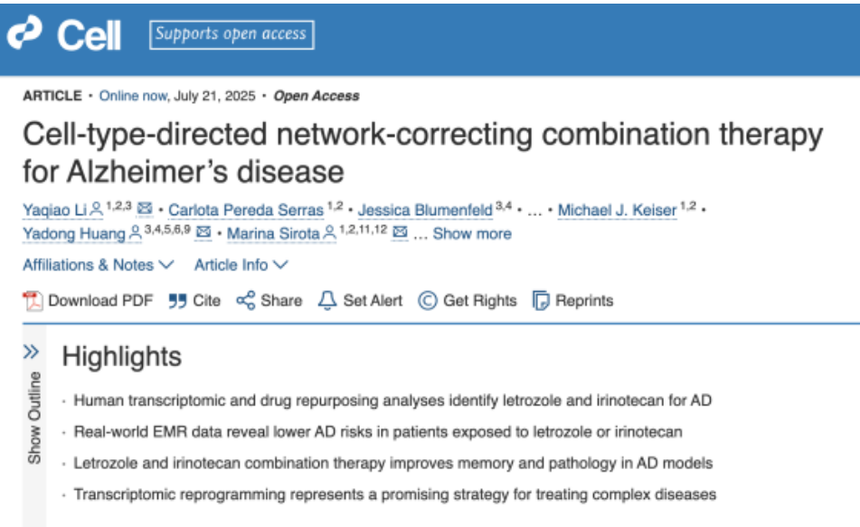
Fortunately, the drug testing was performed successfully. Recently, the research conducted by Yaqiao Li was officially online in Cell. Based on single-cell gene expression data from real patients, the team and Yaqiao Li verified Letrozole and Irinotecan, two drugs originally applied for cancer treatment, have the potential to treat Alzheimer’s disease.
Repurposed Drug: A Dual Approach Alzheimer’s disease is a kind of neurodegenerative disease triggering complex abnormal gene expressions in neurocytes. Conventionally, drug development only targets a single gene or protein that drives disease with limited therapeutic efficacy. Additionally, the current common antibody drugs not only have limited efficacy but also bring innegligible side effects.
According to single-cell gene expression data from real patients, the research team carried out a systematic screening of 1,300 commercially available drugs. Through computational biology analyses, they preliminarily selected 25 drugs that may reverse gene aberration in Alzheimer’s disease. Combining 1.5 million electronic medical records from the University of California Medical Center, the team found that the risk of developing Alzheimer’s disease was significantly reduced in the population taking Letrozole and Irinotecan (by 53% and 80%, respectively), hinting the possible neuroprotective effect of these two drugs.
In mechanism-related research, the team confirmed that Letrozole can mainly improve neuronal gene expression, and Irinotecan targets the dysfunction of glial cells. When the two drugs are used in combination, the memory function of model mice has been restored, the pathological protein deposition has been reduced, and the abnormal gene expression network has been reversed.
Research Breakthroughs under Interdisciplinary Collaboration
Yaqiao Li attributes the achievements to the cultivation of an interdisciplinary mentor team. Marina Sirota, a computational biology mentor, gave her the space to explore freely, while Yadong Huang, an experimental biology expert, provided precise guidance on technical details. “The fusion of the two different scientific research styles yields effects of 1+1>2.” This cross-disciplinary collaboration model enables research to have both the breadth of big data analysis and the depth of experimental validation.
Today, the team plans to promote clinical application of the two drugs. Generally, in the first phase of clinical trials, drugs will be tested in healthy populations; however, they can skip this step directly because these two drugs have already been used for clinical treatment of cancer patients. Yaqiao Li happily stated that the next step will be to directly test Alzheimer’s disease patients to determine the appropriate dosage of medication. This breakthrough not only brings new hope for patients, but also displays the potential of precise medicine in treating neurodegenerative diseases.
For future, Yaqiao Li stated that she will deeply investigate the research direction of “personalized” medical care. She explained that the same disease is influenced by factors such as gender and environment, and different people have different gene expressions. “I want to customize more precise and highly efficient treatment plans for different populations,” she said frankly. If her research can help one or two patients, she would be particularly happy. |