
Please click the button below to go to our email login page
|
IF=8.1, New ideas about Notch signaling pathway! Revealing the role of TRIM59 in pancreatic cancer!The Notch signaling pathway is a highly conserved signal transmission system in the evolutionary process, which can be classified into classical and non-classical types. Classical Notch signaling pathway, also termed CBF-1/RBP-Jκ-dependent pathway, involves ligand-activating Notch receptors, further leading to a series of protease cleavage, release of Notch intracellular domain (NICD), and transcription and activation of downstream genes. Non-classical Notch signaling pathway is independent of ligands, but is possibly related to the activation of Notch receptors in the endoplasmic reticulum or endosomes after endocytosis, as well as the interplay of NICD and non-CSL proteins.
The Notch signaling pathway plays a crucial role in all sexually reproducing multicellular organisms in the animal kingdom, particularly during embryonic development. So, what are some research project ideas related to the Notch signaling pathway?
Next, we will share a paper published on Cell Death & Disease, with an IF of 8.1, hoping to inspire you from different angles.
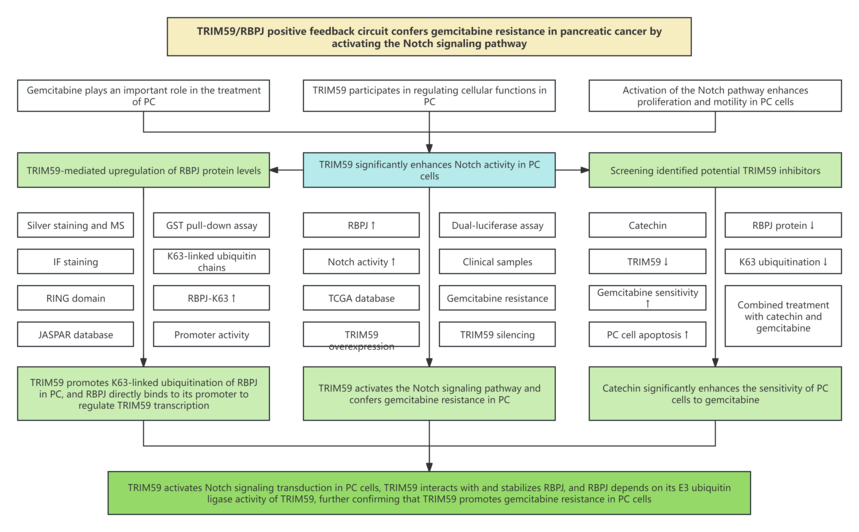
Research background 1. Chemotherapeutic agents, such as gemcitabine, play an essential role in the treatment of pancreatic cancer (PC). 2. Previous studies have shown that TRIM31 and TRIM37 confer resistance to gemcitabine and fluorouracil in PC by activating the NF-κB and AKT-GSK-3β-β-catenin signaling pathways, respectively. 3. TRIM59 participates in the regulation of cellular functional mechanisms in PC. 4. Activation of the Notch pathway causes enhanced proliferation and motility of PC cells. However, the relationship between Notch signaling transduction and TRIM59 in the chemoresistance of PC remains unclear.
Technical routes
Research results 1. TRIM59 has been identified as a key regulator of the Notch signaling pathway in PC. 2. Upregulation of TRIM59 results in poor prognosis and suboptimal response to gemcitabine therapy in PC patients. 3. TRIM59 confers gemcitabine resistance in PC models both in vitro and in vivo. 4. TRIM59 interacts with and stabilizes RBPJ in the PC. 5. TRIM59 promotes K63-linked ubiquitination of RBPJ in PC. 6. RBPJ positively regulates TRIM59 expression at the transcriptional level. 7. The TRIM59 inhibitor catechin suppresses Notch signaling and restores gemcitabine sensitivity in PC cells.
Conclusion This research elucidates that the positive feedback loop plays an important role in gemcitabine resistance in PC, unveiling a new regulatory mechanism. The research found that TRIM59 stabilizes through promoting ubiquitination at the K63 site of RBPJ, and then activates Notch signaling pathway. Meanwhile, RBPJ transcribes and activates TRIM59 expression to form a positive feedback loop. This discovery provides a new treatment target for overcoming chemotherapy resistance in PC. Besides, the TRIM59 inhibitor catechin screened out by researchers has shown a good sensitization effect, providing a promising therapeutic strategy and drug option for the clinical treatment of PC. |