
Please click the button below to go to our email login page
|
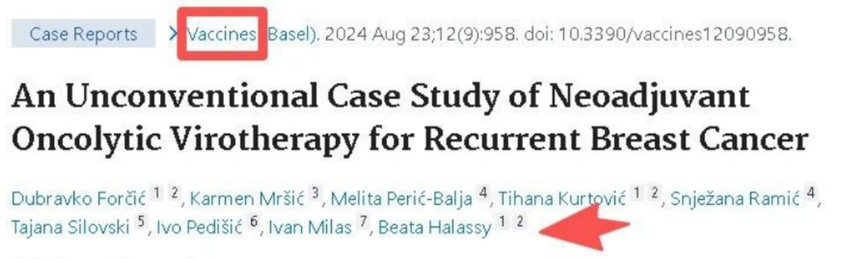
Shock news: Female scientist cures her own cancer with self-developed viruses in lab —and publishes groundbreaking results in Nature!”The Nature News of Nature reported that recently, the virologist Beata Halassy from University of Zagre aroused the wide attention from the academic community due to her special anti-tumor case. Faced with a recurrent breast cancer and chemo-refractory dead end, she treated herself with an unapproved oncolytic virus therapy (OVT), ultimately achieving 4 years of disease-free survival. However, this “self-experiment” has been rejected over 10 times due to the ethical controversy, and finally been published in Vaccines on Aug. 23.
Date back to 2020, Halassy found the recurrence of breast cancer at the site of her previous mastectomy, and her body could no longer tolerate chemotherapy. As a virologist, she turned her sights to OVT, a therapy that attacks caner cells via virus and activates immune system to combat tumors. OVT is primarily applied to advanced metastatic cancer, but currently, there is no OVT drug approved for treating various stages of breast cancer globally.
Drawing on her professional expertise, Halassy selected two viruses already in clinical OVT trials: the measles virus, widely used in childhood vaccines, and the vesicular stomatitis virus (VSV), which causes only mild flu-like symptoms. During the two continuous months, her colleague assisted in directly injecting these two viruses into tumor tissues. The treatment outcome exceeded expectations. Her tumor sharply shrank and softened, without severe side effects. More importantly, the tumor has been successfully separated from surrounding chest muscle and skin, creating favorable conditions for subsequent surgical removal. The postoperative pathological analyses further demonstrated that OVT has effectively activated her immune system, enabling it to attack both virus and tumor cells. Bolstered by a year of additional anticancer medication, Halassy has remained cancer-free for 4 years.
Despite the successful treatment, Halassy hit repeated brick walls when trying to share her results. Due to the apparent ethical controversy about the “self-experiment”, her research paper has been rejected over 10 times by journals. The academic community has been unequivocal: numerous researchers warn that ordinary cancer patients must never emulate this approach and should always follow physicians’ advice to receive conventional therapies. Halassy herself also emphasizes that her treatment relies on long-term accumulated professional knowledge and experimental skills. The ordinary people lack the resources and expertise to replicate the protocol, and copying it blindly is extremely high-risk.
Noteworthily, this special “self-experiment” has changed the research trajectory of Halassy. In September this year, she just received a research grant for “OVT treatment of family cancer”, with in-depth exploration in the future. This act of “self-rescue” may become the new start that propels OVT research. |