
Please click the button below to go to our email login page
|
Breaking! CDC’s over 20-Year-Old Journal is in Trouble? Six Editors Fired, Dozens of Manuscripts Left Unattended, Hundreds of Papers StalledOn October 30, 2025, Science reported that the academic journal “Preventing Chronic Disease” (PCD), which has been established for more than 20 years under the U.S. Centers for Disease Control and Prevention (CDC), is facing a “survival” crisis. Six of the journal’s federal editorial staff received dismissal notices on October 10, which have not been revoked to date, casting uncertainty over the journal’s future.
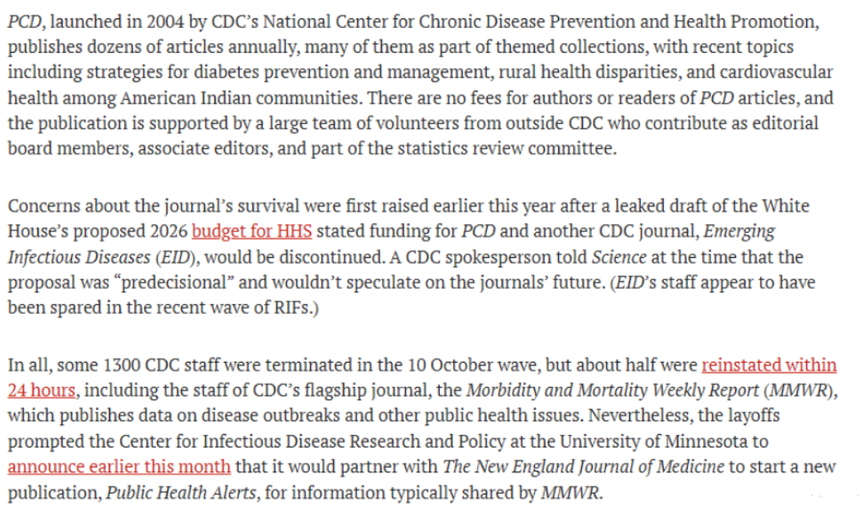
PCD journal was established in 2004 by the National Center for Chronic Disease Prevention and Health Promotion and published over 10 academic papers annually, which cover themes including prevention and treatment of diabetes, health gap in rural areas, and cardiovascular health in Native American communities. The journal does not charge any fees to authors or readers, and its operation is supported by a large number of external volunteers.
The upheaval flows from the U.S. government’s October layoff wave: federal agencies including Department of Health and Human Services (HHS) that oversees the CDC have delivered dismissal notices to over 4000 employees, 1300 of which belongs to CDC. Although roughly half of those CDC workers were reinstated within 24 hours (including the team of a core journal of CDC, Morbidity and Mortality Weekly Report), the six editors of PCD were not on the recall list.
What’s trickier is that since the US government shutdown on October 1, PCD has been identified as “unnecessary program”, and the employees ceased publishing new papers and deactivated their official email accounts, leaving dozens of manuscripts under review in limbo. Many volunteer editors, reviewers and authors have not received dismissal notices. Currently, the latest paper on the journal’s official website dates back to September 25th, without the message of firing situation and future arrangement of journal.
Researchers are outraged. Mark Strand, a chronic disease epidemiologist at North Dakota State University who has both published in the journal and served as an associate editor, calls the situation a “tragedy”. Chronic diseases are the leading cause of death and disability in the US, while the government is threatening to shut down the relevant journal, which is an action devoid of “reason or clear vision”. Lloyd Michener, a researcher at Duke University School of Medicine and member of the journal’s editorial board, also raised questions: “The government claiming to emphasize chronic diseases fired an experienced editorial team. This makes no sense at all.”
In fact, the survival crisis of PCD had long been foreshadowed. At the beginning of 2025, a leaked 2026 HHS budget draft from the White House revealed that the funding of CDC and another journal Emerging Infectious Diseases (EID) would be terminated. At that time, the CDC stated that the budget was still in a “pre-decisional stage” and declined to comment on the future of the journals. In this recent round of layoffs, the EID team was spared.
At present, HHS spokespersons claimed that due to a recent court order, the dismissal notices will not be executed. But the employees from PCD stated that “no one knows how this ends.” The team still hope the journal can be saved, or at least “ended orderly”, ensuring that already-published articles archived, and manuscripts under review transferred to other journals, thereby “reassuring authors that their research will not disappear.”
In the meantime, the government shutdown and CDC layoffs have aroused a chain reaction: the Center for Infectious Disease Research and Policy at the University of Minnesota announced this month that it will collaborate with The New England Journal of Medicine to launch a new journal, Public Health Alert, aiming to fill potential information gaps left by Morbidity and Mortality Weekly Report. |