

Please click the button below to go to our email login page
|
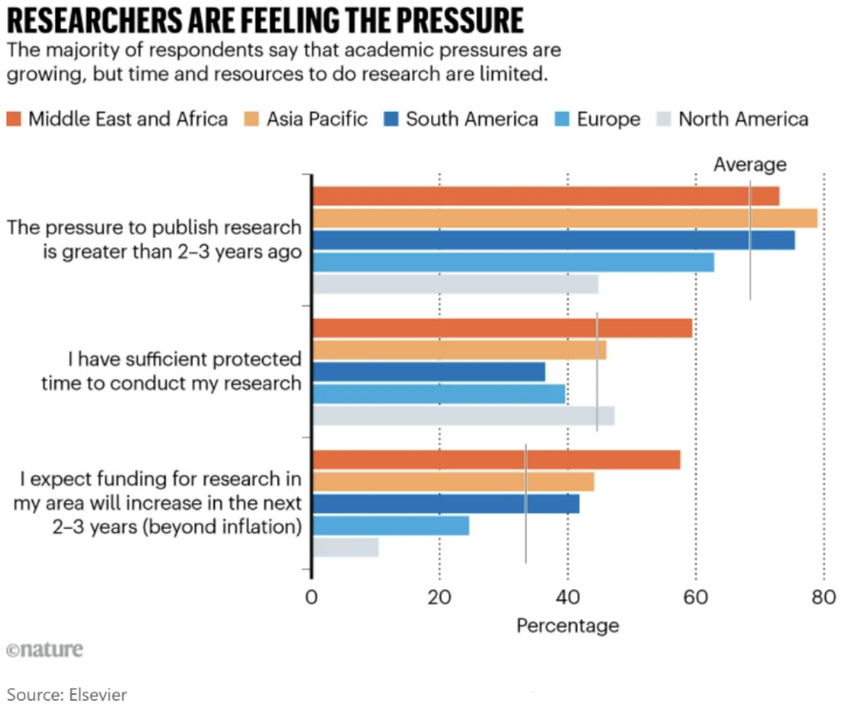
Global researchers are caught in a rat race: The pressure to publish papers is soaring, yet the time for research is dwindling. Where is the way out?Researchers frequently feel that “the pressure to publish papers is soaring, yet the time and resources for research are dwindling”, which is a conclusion stemming from a latest global survey report of Elsevier. This survey includes the feedback of 3200 researchers from 113 countries, and the results have been published on Researcher of the Future 2025.
The pressure to publish papers is soaring, yet the time for research is dwindling
Nearly 68% respondents indicated that in the past two to three years, they felt markedly increasing pressure in publication, while only 45% thought they have sufficient time to conduct scientific research.
In addition, the uncertainty in scientific research funds is also a cause for concern: only 33% researchers estimated that the funds in their research field will increase in the next two to three years, compared to 11% in North America, reflecting that American research funds have experienced an unprecedented reduction this year.
Dr. Claudia Suemoto, a gerontologist from the University of São Paulo School of Medicine, points out that the imbalance of “high demands and few recourses” forces researchers to “achieve more with less”, thereby influencing the quality and creativity of research.
The survey comments revealed that the erosion to research times is mainly attributed to increased tasks of administration and teaching, the burden of applying for and managing grants and the shortage of research personnel.
Researchers are "considering walking away."
The survey showed that nearly 30% of the interviewed scientists are considering relocating to other countries for career development within the next two years.
Astrophysicist Jacco van Loon from Keele University in the UK noted that scientific researchers often travel across countries due to the nature of the academic market, but currently the political factors make profound impacts. The data showed nearly 40% scientific researchers are considering going abroad in America, compared to 13% in China.
Jacco van Loon analyzed: “The government in China provides more attractive policies to scientific research talents, while the U.S. government’s attitude toward the research community has become increasingly hostile, especially on issues related to diversity and inclusion. These data do not surprise me at all.”
In the survey, the main reasons researchers consider relocating include seeking a better work-life balance, securing more funding support and having greater academic freedom.
AI is rapidly permeating scientific research, but governance and training are lagging significantly behind.
Another focus of this survey is the utilization of AI in scientific research: 58% researchers reported using AI tools, only 32% thought their institutions have effective AI governance mechanism, and only 27% felt they have received sufficient AI training.
This trend corresponds to another survey of the publisher Wiley: nearly 5000 researchers from over 70 countries believed that AI will be the key tool for scientific research and publishing, but there is a lack of effective supports.
Nearly 58% researchers felt that AI tool can help save time in the following situations: retrieving and summarizing literature; conducting literature reviews and analyzing data; writing a grant application and drafting research papers.
The challenges faced by the global research community mirror a universal dilemma: the trade-off between time constraints, funding limitations, and research quality.
The true scientific competition lies not only in the number of paper and impact factor, but also the possibility of creating a research environment that allows for “deep thinking and methodical work.”
When publication pressure outweighs the passion for exploration, and when evaluation systems override scientific spirit, the fertile ground for innovation inevitably shrinks.
What we need is not more “quick achievements”, but greater resilience and sustained dedication in scientific research. |